
Recovering an SM2267XT NVMe SSD Stuck in BSY
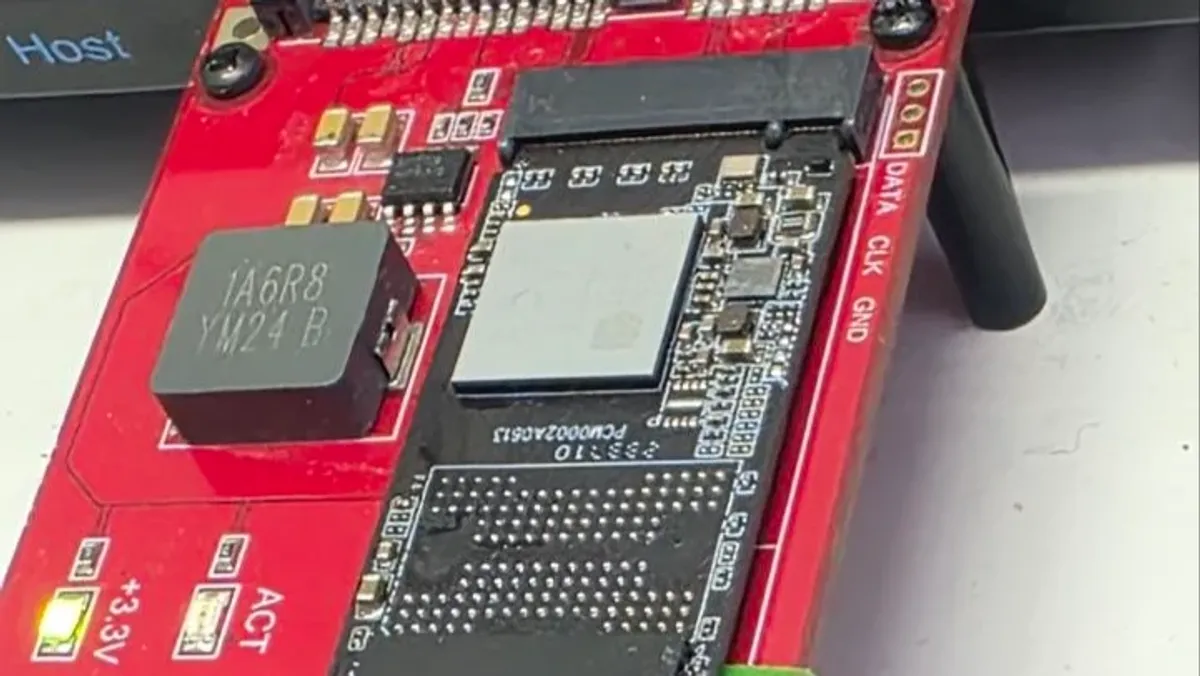
A storage device can appear completely dead even while its controller remains active but unable to finish initialization. That was the condition of this M.2 NVMe SSD, which used a Silicon Motion SM2267XT controller.
The drive arrived at the lab without appearing on the host computer or completing normal NVMe enumeration. To the user, it showed no useful sign of operation. Conventional recovery software could not access it because the operating system had no recognized storage device to communicate with.
Diagnosis: A Controller Stuck in BSY
Diagnostics performed with PC-3000 Portable Pro showed that the controller was stuck in a persistent BSY (Busy) state. It had not reached the normal operating stage required to report the drive’s identity and respond to read commands.
A BSY condition may be associated with a failure while loading firmware information or translation structures required to access data stored on the NAND flash. However, identical symptoms do not guarantee an identical fault or recovery procedure. The controller family, PCB design, and NAND condition must be evaluated for each drive.
Entering Safe Mode
This case required direct intervention on the PCB. The appropriate contact points were used to force the controller to start in Safe Mode instead of remaining trapped in the failed initialization cycle.
Safe Mode does not recover files by itself. It provides a controlled technical state from which further work can begin. Shorting the wrong points or applying the procedure to a different board can cause additional damage, so this is not a general DIY procedure for undetected NVMe drives.
Preparing the Drive for Data Access
After the controller entered Safe Mode, the appropriate Loader was used to establish technical communication. The Translator structure—which connects logical data addresses to their physical locations within the NAND flash—was then processed to restore usable access to the stored data.
Once stable access was available, the data was imaged to safe storage rather than treating the affected SSD as a normal working drive or subjecting it to repeated startup attempts.
Result
The procedure successfully restored access to the client’s data and allowed it to be extracted intact. The case demonstrates that an NVMe SSD that is not detected by a computer is not necessarily empty or permanently unrecoverable. The failure may exist in the controller’s path to initializing and presenting the NAND data to the host.
The procedure cannot be generalized to every undetected SSD. Safe Mode access, Loader selection, and Translator work depend on the controller family, PCB design, and NAND condition. Professional recovery therefore begins with diagnosis, not by repeating the steps used for another drive.