
Recovering RAID 1 Data from Mechanically Damaged SAS Drives
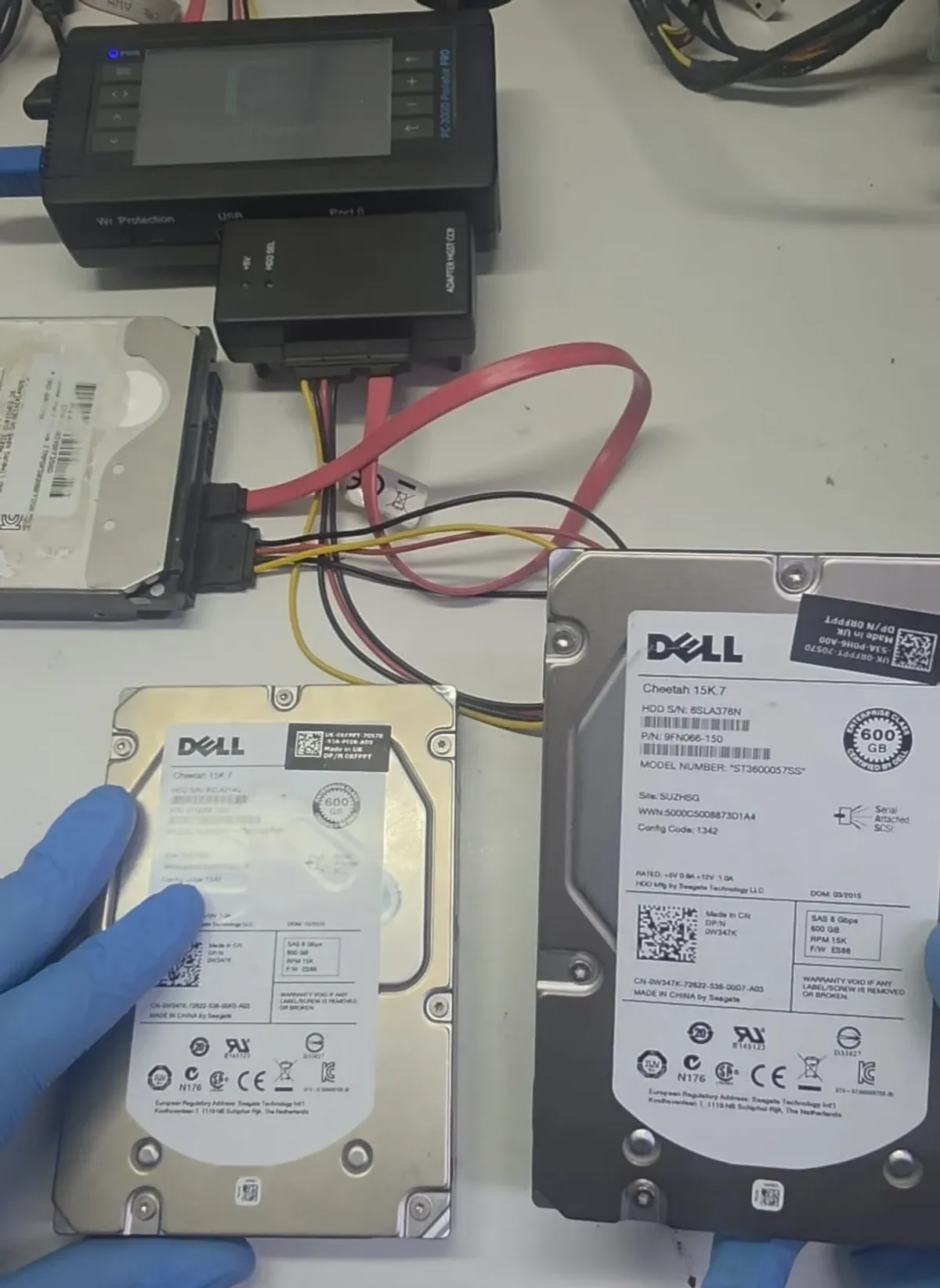
SAS (Serial Attached SCSI) interfaces are the prevailing standard in enterprise storage environments due to high throughput and RAID compatibility. However, when these drives suffer mechanical failures—manifesting as clicking or scratching—recovery demands engineering protocols fundamentally different from consumer SATA units.
Physical Specifics of the SAS Interface
SAS drives feature a unified backplane connector without the gap found in SATA drives, making direct connection to standard motherboards impossible. In our labs, these drives are interfaced via specialized SAS adapters within the PC-3000 SAS professional environment, granting the engineer total control over the Service Area (SA) and technological commands.
Diagnosing Mechanical Faults
Mechanical scratching sounds typically indicate failure in the reader or writer elements of the Head Stack Assembly (MHA) or physical surface scoring on the magnetic platters. In such scenarios, traditional reading attempts pose a severe risk of permanent data loss due to the spread of metallic dust caused by friction.
Stabilizing Extraction via PIO Mode
When a drive is mechanically unstable, high-speed UDMA transfers often cause the firmware to enter a “Busy” (BSY) state upon encountering the first bad sector. Consequently, we implement PIO (Programmed I/O) mode—a slower, stable reading protocol that relies on the processor for sector-by-sector transfer, minimizing stress on the compromised heads.
Damage Bypass Engineering: Jump Settings
To preserve the integrity of the magnetic media, we configure “Jump Settings” within the Data Extractor environment. This algorithm “skips” over a predefined range of sectors (LBAs) as soon as a scratching zone is detected, allowing the extraction of healthy data first before attempting more intensive passes on damaged areas.
RAID 1 Analysis and Reconstruction
Once a stable sector-by-sector image is captured, we proceed to array geometry analysis. In this instance, logical analysis of the block size and data start (Offset) confirmed the system utilized a RAID 1 (Mirroring) configuration, where data is 100% identical across members.
Consistency Verification and Recovery Outcome
Based on the principle of redundancy, the successful extraction from the first drive rendered it unnecessary to further stress the second member, which exhibited similar mechanical symptoms. The recovered image was cloned onto a new medium, and system file integrity was verified, resulting in the full restoration of server operations.